


The Wonders of Physics
In the matter of physics, the first lessons should contain nothing but what is experimental and interesting to see. A pretty experiment is in itself often more valuable than twenty formulae extracted from our minds. --Albert Einstein
General DescriptionNever has there been a time when an understanding of science has been more important to the well-being of individuals and to the nation than the present. Yet many recent studies have documented a lack of interest in science and hence a decline in science literacy in the United States.
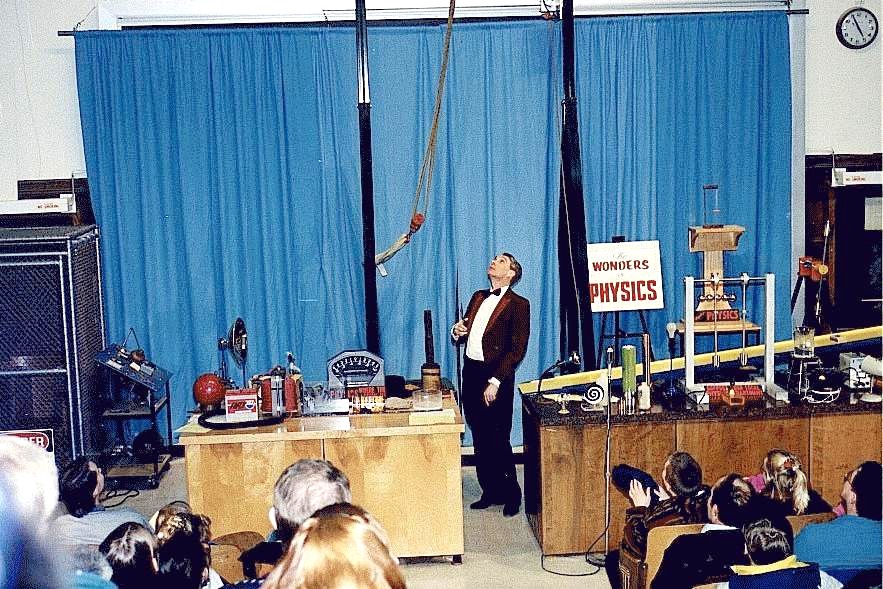
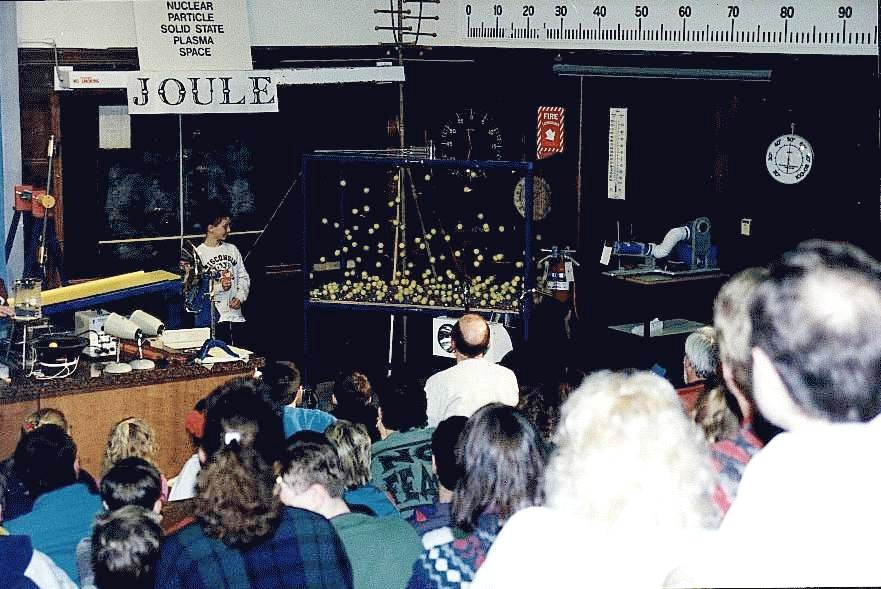
To address this problem, the University of Wisconsin - Madison in 1984 began a program called The Wonders of Physics aimed at generating interest in physics among people of all ages and backgrounds. The heart of the program is a fast-paced presentation of physics demonstrations carefully chosen to be entertaining as well as educational. The show has been presented by Professor Clint Sprott on the Madison campus over 180 times to a total audience of about 60,000. In addition a traveling show has been developed and presented by physics graduate students and staff over a thousand times to audiences of all ages throughout Wisconsin and the nation. A variety of educational tools and materials have been developed including videos, software, a demo book and a lecture kit.
Professor Clint Sprott
Annual PresentationScheduled presentations of The Wonders of Physics and tours of the Physics Department laboratories are given on the UW-Madison campus for the general public in mid-February each year. Free tickets are recommended and are available after January 1st by calling (608) 262-2927, by e-mail to wonders@physics.wisc.edu, or by using the On-Line Ticket Form. The next public presentations of The Wonders of Physics are scheduled as follows: February 9, 2008 at 1 and 4 pm February 10, 2008 at 1 and 4 pm February 16, 2008 at 1 and 4 pm February 17, 2008 at 1 and 4 pmThese presentations will be held in 2103 Chamberlin Hall, 1150 University Avenue, Madison, WI.
Dramatic Entrance
Mini-shows and Traveling ShowsSpecial presentations at the UW-Madison or at your school can usually be arranged for groups of various sizes by calling (608) 262-2927 or by e-mail to wonders@physics.wisc.edu. A donation is requested to cover the cost of these presentations, which is about $200 to $500 plus travel for nonlocal presentations.
Einstein's Brother
Videotapes and DVDsVideotapes (VHS format, other formats by special request) and DVDs (-R) of past presentations of The Wonders of Physics are available for purchase for $25 each or $500 for the entire set (postpaid in the U.S.) from the University of Wisconsin Department of Physics, 1150 University Avenue, Madison, WI 53706-1390. Call (608) 262-2927 or e-mail wonders@physics.wisc.edu to order or for further details. The detailed contents of the videos are available in PDF format. The DVDs will play on computers in all world regions, but they will only play on NTSC DVD players (not European PAL DVD players). The quality of the DVDs is much higher than what you see from the streamed version below. If you have the Windows Media Player 9 or later installed, you can videostream the shows directly to your computer for free by clicking on the links below: Tape 1: 2/11/86 54:33 Classical Physics Tape 2: 6/03/86 51:35 Classical Physics Tape 3: 2/15/87 58:46 Classical Physics Tape 4: 2/21/88 58:46 Classical Physics Tape 5: 6/24/88 28:46 Wonders of Sound Tape 6: 2/19/89 58:46 Classical Physics Tape 7: 2/18/90 58:46 Chaos and Randomness Tape 8: 2/17/91 58:58 Modern Physics Tape 9: 2/23/92 58:46 Physics of the Weather Tape 10: 2/21/93 58:46 Tenth Season Celebration Tape 11: 2/20/94 57:15 Physics of the Body Tape 12: 2/19/95 57:30 Physics of Energy Tape 13: 2/18/96 58:15 Classical Physics Tape 14: 2/16/97 55:23 Physics of Flying Tape 15: 2/15/98 58:43 Fifteenth Season Celebration Tape 16: 2/21/99 59:06 Physics of the Late 1800s Tape 17: 2/20/00 57:59 Physics of the New Millennium Tape 18: 2/18/01 56:15 Physics of the 21st Century Tape 19: 2/17/02 57:26 Physics of Transportation Tape 20: 2/16/03 57:51 Twentieth Season Celebration Tape 21: 2/15/04 58:20 States of Matter Tape 22: 2/20/05 58:56 World Year of Physics Tape 23: 2/19/06 57:48 Celebration of New Lecture Hall Tape 24: 2/18/07 58:26 Physics of Water
Rotating Platform
Demonstration SoftwareTwo educational computer programs, Physics Demonstrations and Chaos Demonstrations, for IBM PC or compatibles are available from Physics Academic Software, Box 8202, North Carolina State University, Raleigh, NC 27695-8202. Call (800) 955-8275 or (919) 515-7447 to order.
Faraday Cage
Physics Demonstrations BookA full-color, 300-page, heavily illustrated book, Physics Demonstrations containing a detailed description of 85 demonstrations used over the years in The Wonders of Physics is available from University of Wisconsin Press. It is accompanied by two closed-captioned DVD's showing all 85 demonstrations presented to a live audience. Organized to teach the six major areas of classical physics -- motion, heat, sound, electricity, magnetism, and light -- the book includes:
a brief description of each demonstration
materials lists, with sources for common materials
preparation procedures
discussions of the physics principles demonstrated
potential safety hazards
references for further information
Physics Demonstrations Book
Lecture KitA kit describing The Wonders of Physics program in detail, with a list of demonstrations, sources, handouts, publicity samples, a DVD of a recent presentation, and the Physics Demonstrations software is available. (See Preface and Table of Contents.) It is aimed at teachers and scientists who want to give similar public presentations in their own communities. Copies are available for $90 (postpaid in the U.S.) from the UW Department of Physics, 1150 University Avenue, Madison, WI 53706-1390, by calling (608) 262-2927, or by e-mail to wonders@physics.wisc.edu.
Lecture Kit
Additional Information The Wonders of Physics Survey The Wonders of Physics Traveling Show Brochure for Educational Products Physics to the People! article in The Physics Teacher (February 1991) Article about The Wonders of Physics in Wisconsin Week (February 18, 2002) Article about The Wonders of Physics in the Wisconsin State Journal (February 19, 2006) Press report and video from show at University of Aveiro, Portugal (July 24, 2006) Preface and Table of Contents from The Wonders of Physics Lecture Kit Quotes from audience members and the press Theme music from The Wonders of Physics Physics Demonstrations very early manuscript of a published book Saunders Physics Demonstrations video Experiments you can do at Home Demonstration Explanations: A Teacher's Guide A slide presentation about The Wonders of Physics Updated Poster from November 1996 Denver APS meeting (also in MS-Word format) Talk given at the November 1996 Denver APS meeting Additional photographs of The Wonders of Physics Data Base of Physics Lecture Demonstrations at the University of Wisconsin
The Wonders of Physics is supported in part by the Fusion Energy Sciences Program of the U.S. Department of Energy and in part by the National Science Foundation.
Grand Finale
Total accesses:
Back to the server home page
Thursday, August 23, 2007








_
The Nature Conservancy in ChinaChinaContact UsPlaces We ProtectHow We WorkChina FeaturesChina News Ways of Giving
Get Involved
Receive our free e-newsletter and learn about our work to preserve biodiversity — in China and around the globe.
Visit Yunnan Province
See a Photo Essay on the beautiful Yunnan Province, including images of the new Pudacuo National Park.
“Pudacuo National Park is significant — more land is protected through this new model than could have been done before.”
—Jerry Chen, project manager of the Conservancy’s Yunnan program
Go Deeper
Learn more about other prospective national park sites in China, including Meili Snow Mountain and Laojun Mountain.
function popimage(imagesrc,winwidth,winheight){
var look='width='+winwidth+',height='+winheight+','
popwin=window.open("","",look)
popwin.document.open()
popwin.document.write('Yunnan Province Photo Essay')
popwin.document.close()
}
The Nature Conservancy has helped China achieve a conservation landmark: the establishment of that country's first national park, which will also serve as a model for a new Chinese national park system.
The new park — Pudacuo National Park in China's Southwest Yunnan Province — is located in one of the most biodiverse regions of the world. While the region comprises only 0.7 percent of China's land area, it contains more than 20 percent of the country’s plant species, about one-third of its mammal and bird species and almost 100 endangered species.
But the establishment of Pudacuo National Park is significant in other ways as well:
It increases conservation in the region by incorporating 10 times more land into an area that was formerly a nature reserve;
It introduces skilled park management techniques to help abate threats to biodiversity in the area;
It provides a source of environmental education for local communities; and
It provides economic benefits to local communities through park-related jobs and ecotourism.
The Conservancy supported the Chinese government's efforts to establish Pudacuo in June 2007 by introducing the concept of the national park system to officials and advising the government on how best to establish this kind of protected area.
“Pudacuo National Park is significant," says Jerry Chen, project manager of the Conservancy's Yunnan program. "More [land] is protected through this new model than could have been done before."
A National Park for China
By any standard, Pudacuo qualifies as a natural wonderland. It contains endemic species of fish found no where else in the world, rare and beautiful orchids, black-necked cranes and taxus yunnanensis, a yew whose extracts are indispensable to the creation of many cancer drugs.
While there are more than 2,300 nature reserves in China, only a fraction are in areas of critical biological importance, and an even smaller number are well-managed. Pudacuo will meet the standards for national parks established by The World Conservation Union (IUCN) — and also advance both protection and sustainable development of this ecologically significant section of Yunnan Province.
The Conservancy introduced the national park system to China as part of a partnership with the Chinese government. The partnership included study tours for local, provincial and national Chinese government officials to such places as Yellowstone National Park in the United States and Komodo National Park in Indonesia, where they observed examples of protected-area management and learned about park design, infrastructure development and tourism management.
Nature for People, Not Nature from People
Pudacuo National Park is also an example for local Chinese governments of how a well-managed park can be both ecologically and economically valuable. For example, the park helps the local economy through providing neighboring residents jobs in park management.
“What…distinguishes this park [from a typical Chinese nature reserve] is that the local communities are already benefiting from it because they are preferentially employed for jobs within the park,” says Zhu Li, communications manager for the Conservancy’s China Program. “The national park system embodies the conservation ideal of ‘nature for people’ rather than ‘nature from people.’”
“The national park system embodies the conservation ideal of ‘nature for people’ rather than ‘nature from people.'”
— Zhu Li, communications manager for the Conservancy’s China Program
The Conservancy has provided critical support in this effort — drawing on a history of conservation success in the Yunnan Province in which it has specifically linked poverty alleviation and human well-being with environmental conservation and sustainability.
Tourism is another key aspect of Pudacuo's development. Nestled in the mountains of southwest China, the park is an integral part of the Three Parallel Rivers Scenic Area, a UNESCO World Heritage Site and one of China’s most popular tourist destinations.
By helping the Chinese government properly plan for and manage tourism through this model national park, the Conservancy is providing the government with an opportunity to reduce the impacts of tourism and other threats to biodiversity in one of the world’s most ecologically valuable natural areas.
And the Conservancy has also worked with government officials, the academic community and non-profit partners to address the lack of adequate resources and training that prevent reserve managers from being able to effectively manage their parks.
“We are also working with communities inside and outside of the park to build participation through co-management, alternative energy, green building and ecotourism,” says Chen. “We want to abate the threats to biodiversity in this region and help communities benefit from the establishment of a national park."
Nature picture credits (top to bottom, left to right): Photo © Li Haomin (Pudacuo National Park); Photo © Zhu Li (Bita Lake, Pudacuo National Park); Photo © Zhu Li (Shudu Lake, Pudacuo National Park).
Tell a friend
RSS Subscribe to our news feed Printer friendly-->
Carbon Calculator
Site Map
Contact Us
Help/FAQs
Careers
Privacy
Governance
Financials
Legal Disclosure
Copyright © 2007 The Nature Conservancy

_ujv='1.5';
_ujv='1.4';
_ujv='1.3';
The Nature Conservancy in ChinaChinaContact UsPlaces We ProtectHow We WorkChina FeaturesChina News Ways of Giving
Get Involved
Receive our free e-newsletter and learn about our work to preserve biodiversity — in China and around the globe.
Visit Yunnan Province
See a Photo Essay on the beautiful Yunnan Province, including images of the new Pudacuo National Park.
“Pudacuo National Park is significant — more land is protected through this new model than could have been done before.”
—Jerry Chen, project manager of the Conservancy’s Yunnan program
Go Deeper
Learn more about other prospective national park sites in China, including Meili Snow Mountain and Laojun Mountain.
function popimage(imagesrc,winwidth,winheight){
var look='width='+winwidth+',height='+winheight+','
popwin=window.open("","",look)
popwin.document.open()
popwin.document.write('Yunnan Province Photo Essay')
popwin.document.close()
}
The Nature Conservancy has helped China achieve a conservation landmark: the establishment of that country's first national park, which will also serve as a model for a new Chinese national park system.
The new park — Pudacuo National Park in China's Southwest Yunnan Province — is located in one of the most biodiverse regions of the world. While the region comprises only 0.7 percent of China's land area, it contains more than 20 percent of the country’s plant species, about one-third of its mammal and bird species and almost 100 endangered species.
But the establishment of Pudacuo National Park is significant in other ways as well:
It increases conservation in the region by incorporating 10 times more land into an area that was formerly a nature reserve;
It introduces skilled park management techniques to help abate threats to biodiversity in the area;
It provides a source of environmental education for local communities; and
It provides economic benefits to local communities through park-related jobs and ecotourism.
The Conservancy supported the Chinese government's efforts to establish Pudacuo in June 2007 by introducing the concept of the national park system to officials and advising the government on how best to establish this kind of protected area.
“Pudacuo National Park is significant," says Jerry Chen, project manager of the Conservancy's Yunnan program. "More [land] is protected through this new model than could have been done before."
A National Park for China
By any standard, Pudacuo qualifies as a natural wonderland. It contains endemic species of fish found no where else in the world, rare and beautiful orchids, black-necked cranes and taxus yunnanensis, a yew whose extracts are indispensable to the creation of many cancer drugs.
While there are more than 2,300 nature reserves in China, only a fraction are in areas of critical biological importance, and an even smaller number are well-managed. Pudacuo will meet the standards for national parks established by The World Conservation Union (IUCN) — and also advance both protection and sustainable development of this ecologically significant section of Yunnan Province.
The Conservancy introduced the national park system to China as part of a partnership with the Chinese government. The partnership included study tours for local, provincial and national Chinese government officials to such places as Yellowstone National Park in the United States and Komodo National Park in Indonesia, where they observed examples of protected-area management and learned about park design, infrastructure development and tourism management.
Nature for People, Not Nature from People
Pudacuo National Park is also an example for local Chinese governments of how a well-managed park can be both ecologically and economically valuable. For example, the park helps the local economy through providing neighboring residents jobs in park management.
“What…distinguishes this park [from a typical Chinese nature reserve] is that the local communities are already benefiting from it because they are preferentially employed for jobs within the park,” says Zhu Li, communications manager for the Conservancy’s China Program. “The national park system embodies the conservation ideal of ‘nature for people’ rather than ‘nature from people.’”
“The national park system embodies the conservation ideal of ‘nature for people’ rather than ‘nature from people.'”
— Zhu Li, communications manager for the Conservancy’s China Program
The Conservancy has provided critical support in this effort — drawing on a history of conservation success in the Yunnan Province in which it has specifically linked poverty alleviation and human well-being with environmental conservation and sustainability.
Tourism is another key aspect of Pudacuo's development. Nestled in the mountains of southwest China, the park is an integral part of the Three Parallel Rivers Scenic Area, a UNESCO World Heritage Site and one of China’s most popular tourist destinations.
By helping the Chinese government properly plan for and manage tourism through this model national park, the Conservancy is providing the government with an opportunity to reduce the impacts of tourism and other threats to biodiversity in one of the world’s most ecologically valuable natural areas.
And the Conservancy has also worked with government officials, the academic community and non-profit partners to address the lack of adequate resources and training that prevent reserve managers from being able to effectively manage their parks.
“We are also working with communities inside and outside of the park to build participation through co-management, alternative energy, green building and ecotourism,” says Chen. “We want to abate the threats to biodiversity in this region and help communities benefit from the establishment of a national park."
Nature picture credits (top to bottom, left to right): Photo © Li Haomin (Pudacuo National Park); Photo © Zhu Li (Bita Lake, Pudacuo National Park); Photo © Zhu Li (Shudu Lake, Pudacuo National Park).
Tell a friend
RSS Subscribe to our news feed Printer friendly-->
Carbon Calculator
Site Map
Contact Us
Help/FAQs
Careers
Privacy
Governance
Financials
Legal Disclosure
Copyright © 2007 The Nature Conservancy
Subscribe to:
Posts (Atom)